
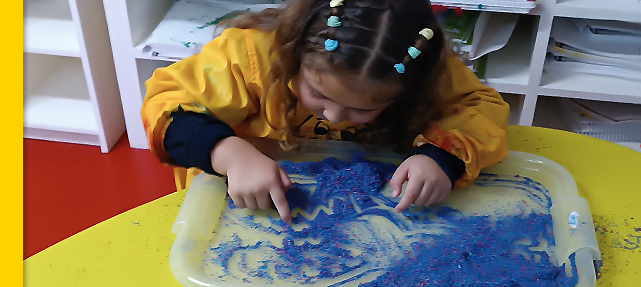
Pre-writing skills are the basic shapes (lines, curves, etc.) that make up the alphabet and numbers. Before a child can reproduce the letter ‘A’ on paper, their brain needs to understand and practice these strokes through their senses. This is where the tray with sawdust comes into play, offering a powerful sensory connection.
The rough and granular texture of the sawdust provides unparalleled tactile stimulation. When tracing, the child doesn’t just see the shape; they feel it with their fingertip. This sensation activates areas of the brain related to motor memory, making the learning process more lasting.
Furthermore, this activity requires the eyes to follow the movement of the finger as it creates a visible mark in the sawdust. This repetitive and focused action is essential for developing hand-eye coordination, which is a key skill that will allow the child to read a word and reproduce it in their notebook.
The use of these trays with sensory materials prevents early frustration associated with the fine motor control of a pencil. Mistakes are easy to correct; you just shake the tray, and the learning will be completely playful.



Pregrafismo y sentidos
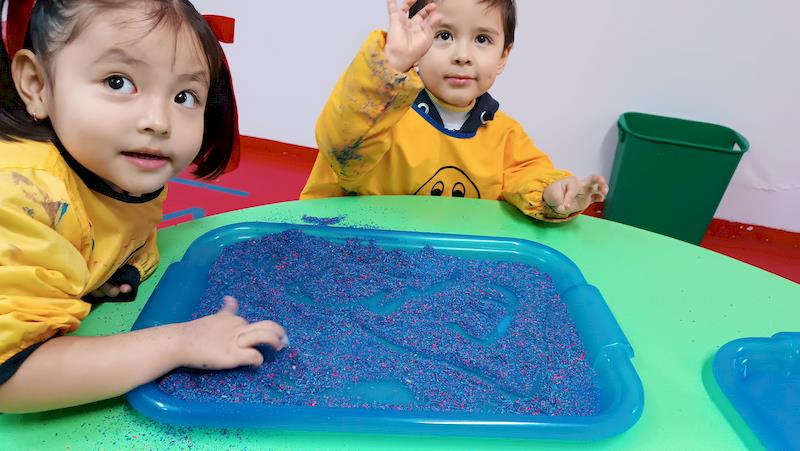
Los pregrafismos son las formas básicas (líneas, curvas, etc) que constituyen el abecedario y los números. Antes de que un niño pueda reproducir la letra ‘A’ en papel, su cerebro necesita entender y practicar estos trazos a través de sus sentidos. Aquí es donde entra en juego la charola con aserrín, ofreciendo una poderosa conexión sensorial.
La textura áspera y granulosa del aserrín proporciona una estimulación táctil inigualable. Al trazar, el niño no solo ve la forma, sino que la siente con la yema del dedo. Esta sensación activa áreas del cerebro relacionadas con la memoria motriz, haciendo que el aprendizaje sea más duradero.
Además, esta actividad exige que los ojos sigan el movimiento del dedo mientras este crea una marca visible en el aserrín. Esta acción repetitiva y enfocada es esencial para desarrollar la coordinación mano-ojo, la cual es una habilidad clave que permitirá al niño leer una palabra y reproducirla en su cuaderno.
El uso de estas charolas con materiales sensoriales evita la frustración temprana asociada al control fino de un lápiz. Los errores son fáciles de corregir; solo se sacude la charola, y el aprendizaje será completamente lúdico.
Ana González
K1B English Teacher